- Engineering
- 8 min read
AI Cost Optimization: How to Reduce AI Costs in Production

Cost Management + AI Gateway
On this page
- What AI Cost Optimization is
- 1. Know what each operation costs
- 2. Not every operation needs the most powerful model
- 3. Keep token growth under control
- 4. AI agents need operational limits
- 5. Centralize usage in an AI gateway
- 6. Turn the budget into an execution policy
- 7. How AIUBY approaches AI Cost Optimization
- 8. Which metrics to track
- Limits of what the platform measures today
- The future of AI is also economic
Putting AI into production has never been more accessible. Keeping it economically sustainable is another matter. An application built on language models can start at an almost negligible cost; as users, agents, integrations and automated processes grow, usage grows with them, and not always in proportion to the value delivered.
The problem is not always the price of the models. Often it is the architecture that decides how they are used. That is where AI cost optimization comes in.
#What AI Cost Optimization is
AI Cost Optimization is the practice of measuring, analyzing and reducing the cost of using AI while keeping the application's quality, security, availability and performance requirements. In LLM applications, cost depends on how the software behaves: each call costs a different amount depending on
- the model used;
- input and output tokens;
- context size;
- how many calls an agent makes to finish a task;
- reprocessing and retries;
- the inference infrastructure;
- surrounding resources such as embeddings and vector storage.
Cost stops being only a finance topic. It becomes a property of the architecture.
#1. Know what each operation costs
Knowing how much the organization spent on AI this month is not the same as understanding the cost. Engineering needs to answer more specific questions: how much does it cost to resolve a support ticket, review a pull request, process a document, run an agent or serve a customer?
| Indicator (hypothetical example) | Application A | Application B |
|---|---|---|
| Requests per month | 100,000 | 100,000 |
| Average cost per request (USD) | 0.04 | 0.015 |
| Monthly cost (USD) | 4,000 | 1,500 |
| Success rate | 95% | 95% |
Both applications have the same volume and the same success rate, but the second one costs 62.5% less per month. The difference may come from model choice, context size or the number of calls needed to complete each operation.
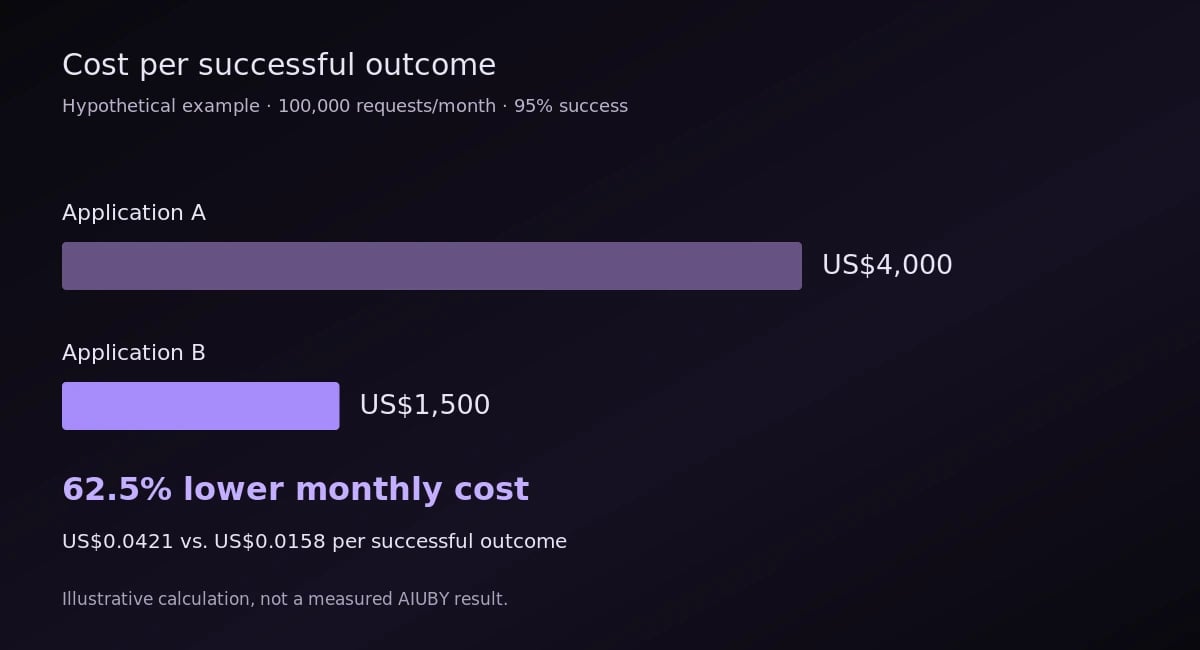
That is why the metric that matters most is cost per successful outcome, not just cost per token. In the example, each valid outcome costs about 4.2 cents for Application A and 1.6 cents for Application B.
#2. Not every operation needs the most powerful model
Using the most advanced model for every request is easy to implement, but it can be needlessly expensive. Document classification, information extraction, message categorization and other structured tasks can often run on smaller models. Complex reasoning, code analysis or reading a lot of context may justify a larger one.
This practice is called model right-sizing: each class of operation uses the class of model that can handle it. But lowering inference cost cannot mean lowering quality blindly. Every model change needs evaluations that represent the application's expected behavior.
#3. Keep token growth under control
One of the least visible costs is the gradual growth of prompts. The application starts by sending a simple instruction and, over time, adds conversation history, documentation, examples, business rules, tool results and chunks retrieved from vector stores. Operations that look the same end up consuming very different amounts of tokens.
- Remove repeated information from prompts.
- In RAG pipelines, retrieve only the relevant documents.
- Limit the history sent to the model.
- Use structured outputs when it makes sense.
- Use prompt caching when the provider offers it.
- Set an output token limit (
max_tokens).
The context available should not, on its own, decide the context used.
#4. AI agents need operational limits
The cost of an agent is not the cost of one request. An agent can call the model several times, query tools, analyze results, repeat steps and trigger other agents. Without controls, a simple task turns into dozens of inference calls.
- budget per run;
- limits on steps and model calls;
- a deadline to finish;
- a retry policy;
- a stop criterion;
- human approval for operations with side effects.
These controls are not only about cost: they also make the agent's behavior predictable.
#5. Centralize usage in an AI gateway
When every application and team calls the provider directly, the organization loses visibility: each integration has its own key, configuration and monitoring. An AI gateway sits between the applications and the model providers and becomes the common point for authentication, tracing, usage metering, access policies and financial governance.
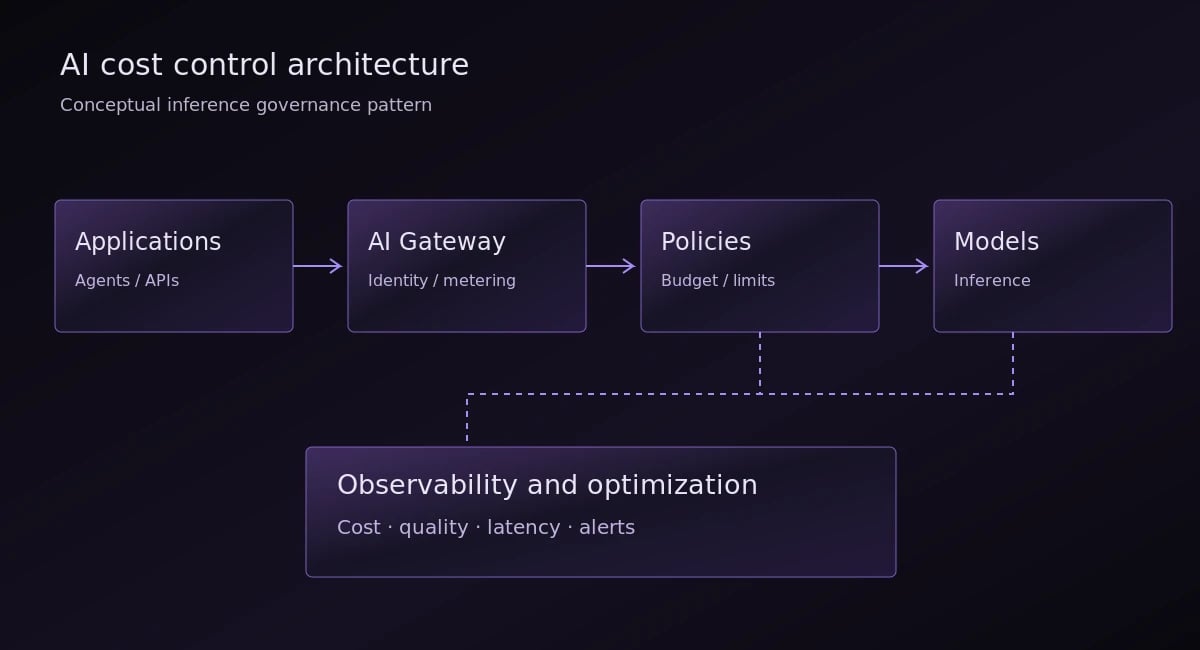
The goal is not to add complexity to the inference path, but to have a consistent control point. How the AIUBY gateway decides before calling the provider, and why it denies when configuration is missing, is in spending blocked by default.
#6. Turn the budget into an execution policy
Dashboards show what already happened, but they do not stop an application from going over budget. FinOps for AI has to combine observability with preventive control: limits set before execution, by organization, workspace, project, model and access key, with alerts as usage gets close to them. Financial control stops being only retrospective and becomes part of the application runtime.
#7. How AIUBY approaches AI Cost Optimization
At AIUBY, Cost Management and the AI gateway (the Models & Gateway part of AI Engineering) work together on the AI usage that goes through the platform. We checked every item below against the platform code on 2026-11-28.
- Cost of every call. Every call through the gateway records tokens, latency and cost, calculated from the model's price table so that it is never underestimated.
- Attribution. Usage is grouped by workspace, person, key, model and project. The project is the tag the application sends in the
x-aiuby-projectheader. - Budget before the call. The workspace's monthly budget is required, the organization cap adds up all workspaces, and there are rules per person, key, model or project that either block or only warn. All of it is checked before the provider is called.
- Alerts. Rules and the workspace budget warn at 50, 80 and 100%, by email to the organization owners and in the audit trail.
- Out-of-pattern spend. The usage dashboard flags the day cost leaves the pattern of the previous days and shows the top contributors.
- Recommendations. Oversized model and bloated prompt, based on the calls of the last 30 days. No change is applied on its own: the team decides, weighing the application's quality.
- History. One row per call, filterable and exportable to CSV.
- Agents. Each agent version has a cost cap per run, a limit on model calls and a deadline; actions with side effects ask for approval. Details in Agents, in the docs.
Each control, step by step and with its response codes, is in AI cost management: measure by key and project, alert and cap and in Budget and allowed models.
#8. Which metrics to track
Optimization has to look at technical and financial indicators together.
| Metric | What it is for |
|---|---|
| Cost per request | Average cost of each call |
| Cost per successful outcome | What each valid result costs |
| Tokens per request | Shows context growing |
| Cost per agent run | What each agent task costs |
| Cost per project | Who each expense belongs to |
| Budget utilization | How much of the budget is already used |
| Evaluation pass rate | Whether quality held after optimizing |
| Retry rate | Reprocessing that should not happen |
| Inference latency | The effect of optimization on performance |
Optimization has only worked when cutting cost does not hurt the expected result.
#Limits of what the platform measures today
- Only usage that goes through the AI gateway is metered per call. A key used directly with the provider is outside the count.
- The platform does not measure prompt caching savings, and the recommendations do not take cache into account.
- When the provider fails, times out or rate limits, the gateway can route the call to the configured fallback model; there is no separate retry policy per key.
- The budget is checked before each call, so the last call before the limit can go slightly over it. The same applies to an agent's cost cap, checked before each step.
- Out-of-pattern spend shows in the dashboard; today it does not send a notification.
- Model-change recommendations infer task complexity only from token counts. That is why they are never applied without a person.
Note
#The future of AI is also economic
Once AI is part of critical processes, the conversation is no longer only about technical capability; it also covers efficiency, financial predictability and sustainability. The best AI architecture is not the one that uses the most powerful model everywhere. It is the one that delivers the required result with quality, security and a cost that can be justified.
To estimate the usage of your next application, use the AI usage calculator. To measure, cap and optimize what is already in production, see Cost Management. More posts on the subject are in the AI cost topic.